Losing a tooth is stressful enough — but then your dentist hands you a choice between a dental bridge and a dental implant, and suddenly it feels like a pop quiz you never studied for. The good news is that both options can give you a healthy, natural-looking smile, and this guide will make the decision simple.
Whether you just lost a tooth or you’ve been putting off the decision for months, this patient resource from Stone Creek Village Dentistry in Del Rey Oaks walks you through everything you need to know — in plain, easy-to-understand language.
What Is a Dental Bridge?
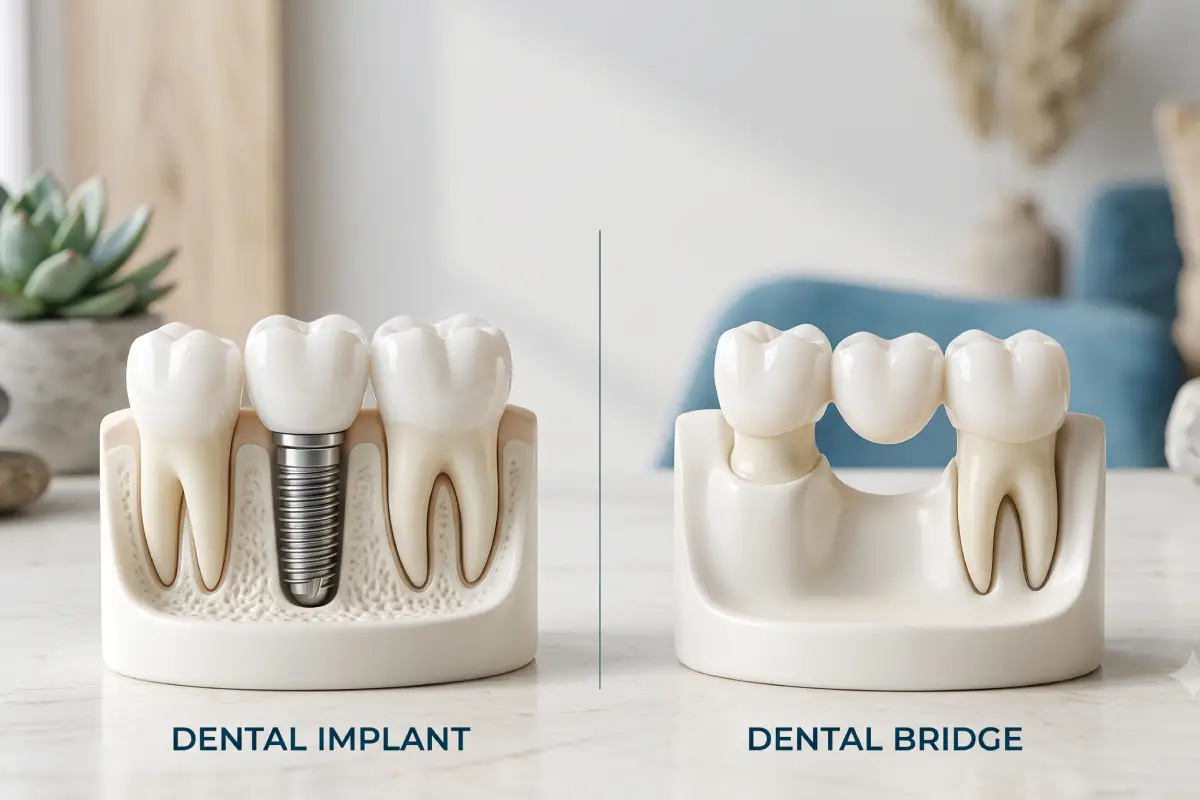
A dental bridge is exactly what the name says — it bridges the gap left by one or more missing teeth. It uses the teeth on either side of the gap as anchors (called abutment teeth) to hold an artificial tooth (called a pontic) in place.
Here is how it works:
- Your dentist files down the two healthy teeth next to the gap
- Custom crowns are placed on those teeth
- A false tooth is cemented in the middle, spanning the open space
- The whole thing is permanently fixed — you cannot take it out
Bridges are usually made from porcelain, zirconia, or porcelain-fused-to-metal. They look very natural and feel comfortable for most patients.
Bridges are a great option if:
- You want a faster solution (usually 2–3 dental visits over a few weeks)
- You prefer no surgery
- Your budget is tighter right now
- The teeth on either side of the gap already need crowns
What Is a Dental Implant?
A dental implant replaces a missing tooth from the root up. A small titanium post is placed into your jawbone during a minor surgical procedure. Over the next few months, the post bonds with your bone — a process called osseointegration. Once fully healed, a custom-made crown is placed on top.
Here is what makes implants unique:
- They work independently — no neighboring teeth are touched
- The titanium post stimulates your jawbone and prevents bone loss
- They look and feel just like a natural tooth
- With proper care, they can last 20–30 years or longer
Implants are the best choice if:
- You want a long-term, permanent solution
- You want to protect your jawbone and overall facial structure
- You want to keep your healthy neighboring teeth untouched
- You are in good general health and have enough jawbone density
Dental Bridges vs Implants: Side-by-Side Comparison
| Feature | Dental Bridge | Dental Implant |
|---|---|---|
| Procedure | Non-surgical | Minor oral surgery |
| Timeline | 2–3 weeks | 3–6 months |
| Lifespan | 10–15 years | 20–30+ years |
| Bone preservation | No | Yes |
| Affects nearby teeth | Yes (filed down) | No |
| Cleaning | Needs floss threader | Brushes like natural teeth |
| Upfront cost | $2,000–$5,000 | $3,000–$6,000+ per tooth |
| Insurance coverage | Often partially covered | Less commonly covered |
| Feel | Natural, fixed | Most natural-feeling option |
Cost of Dental Bridges vs Implants in California (2026)
Cost is one of the biggest factors patients consider, and it is important to look at both the short-term and long-term price.
Dental Bridge Cost
A traditional 3-unit dental bridge (the most common type, which replaces one missing tooth using two crowns on adjacent teeth) typically costs $2,000–$5,000 in California. The price depends on the materials used, the location of the missing tooth, and the complexity of your case.
Most dental insurance plans cover bridges as a “major restorative” procedure, often at 50% after your deductible, depending on your annual benefit maximum.
Dental Implant Cost
A single dental implant in California runs $3,000–$6,000 on average, which includes the implant post, abutment connector, and custom crown. If you need bone grafting first, that can add to the total.
Standard dental insurance plans often do not cover implants, though some premium PPO plans offer partial coverage. Many patients use financing options like CareCredit, HSA/FSA accounts, or in-office payment plans to make implants affordable.
The Long-Term Math
Here is something most patients do not think about upfront: a bridge that costs $2,500 today may need to be replaced every 10–15 years. Over 30 years, you could spend $7,500 or more on bridge replacements. A single implant that costs $4,500 and lasts a lifetime is often the more cost-effective choice in the long run.
At Stone Creek Village Dentistry, we offer flexible financing options so you can get the care you need without financial stress. Call us at (831) 920-6900 to learn about our current payment plans.
Lifespan and Durability
This is one of the most common questions patients ask, and the answer matters a lot for your decision.
Dental bridges typically last 10–15 years with good oral hygiene and regular dental visits. Some last longer, but the biggest risk is decay in the anchor teeth underneath the crowns. If those teeth develop problems, the entire bridge can fail.
Dental implants are the gold standard for longevity. Studies show implant survival rates of about 95% over 10 years, and many patients keep their implants for 25 years or more. The crown on top may need replacement after 15–25 years, but the titanium post itself is often a once-in-a-lifetime investment.
How Do They Feel? Comfort and Daily Life
Both options feel and look natural to most people. However, there are some daily life differences worth knowing:
Bridge care: You cannot floss normally between the bridge teeth. You will need a floss threader or a water flosser to clean underneath the pontic. This takes a little practice but becomes routine quickly.
Implant care: You brush and floss a dental implant exactly like a natural tooth. No special tools needed. This is one of the biggest quality-of-life advantages implants offer.
When it comes to eating, both bridges and implants restore your ability to chew normally. Patients with implants often report feeling the most confident biting into foods like apples or steak because the implant is rooted firmly in the bone — just like a real tooth.
What Happens to Your Jawbone?
This is the detail that most patients do not hear until it is too late: when a tooth root is missing, the jawbone begins to shrink.
When you get a dental bridge, the artificial tooth sits on top of the gum but does not replace the missing root. Over time, the bone under the pontic can gradually shrink. This can change the shape of your face slightly and may cause the bridge to feel loose eventually.
A dental implant acts as an artificial root, actively stimulating the jawbone the same way a natural tooth does. This prevents bone loss and helps maintain your facial structure long-term.
If you have had a missing tooth for a while, some bone may have already been lost. In that case, a bone graft may be needed before placing an implant — but this is more common than you might think, and our team at Stone Creek Village Dentistry can evaluate your situation with 3D digital imaging to give you a clear picture.
Who Is a Good Candidate for Each Option?
You may be a better candidate for a dental bridge if:
- You need a replacement tooth quickly
- You are not comfortable with surgery or do not qualify medically
- The teeth beside the gap already need crowns
- Your budget only allows for a less expensive upfront cost
- You are missing multiple consecutive teeth (a bridge can span several in a row)
You may be a better candidate for a dental implant if:
- You have enough healthy jawbone to support the post
- You are in good overall health with no conditions that affect healing
- You want a permanent, lowest-maintenance solution
- You want to protect the healthy teeth beside the gap
- You are thinking about the long-term value of your investment
The only way to know for sure is a consultation with your dentist. Our team uses advanced imaging to evaluate your bone health and recommend the right option for your specific situation.
What About Implant-Supported Bridges?
There is also a hybrid option worth knowing about: an implant-supported bridge. Instead of anchoring a bridge to natural teeth, it is anchored to two dental implants on either side. This is ideal when you are missing multiple teeth in a row.
Benefits of implant-supported bridges:
- No healthy adjacent teeth are filed down
- Better bone preservation than a traditional bridge
- More stable and longer-lasting than a traditional bridge
- Often less expensive than placing individual implants for each missing tooth
Cost for this option typically ranges from $5,000–$15,000 depending on the number of teeth replaced and complexity of your case.
Why Choose Stone Creek Village Dentistry Near Monterey?
At Stone Creek Village Dentistry, we believe every patient deserves to understand their options fully before making any decision. Here is what sets our Del Rey Oaks office apart:
- Experienced team led by Dr. James Kim and Dr. Xenia Rodriguez — compassionate, patient-first care
- Advanced technology including digital X-rays and 3D imaging for precise planning
- Both dental bridges AND implants offered in one location — no specialist referrals needed
- Flexible financing options to make care accessible for every budget
- Convenient location at 463 Canyon Del Rey Blvd, Del Rey Oaks — easy to reach from Monterey, Seaside, and Carmel
- Same-day emergency appointments available
We serve patients from across the Monterey Peninsula. Whether you are in Del Rey Oaks, Monterey, Seaside, or Carmel, our office is a short, easy drive on Highway 68.
“After struggling with loose dentures, I finally opted for implants at Stone Creek Village Dentistry. The entire process was smooth, and I couldn’t be happier with the results.” — A Satisfied Patient from Monterey
Information in this guide is for educational purposes only and does not replace a personalized consultation with a licensed dental professional.